
How much is a mom's work worth? INEGI already did the math (and the number will surprise you)
Unpaid household work equals 23.9% of Mexico's GDP, and women generate 72.6% of that value. Here's what it means for your family's finances.
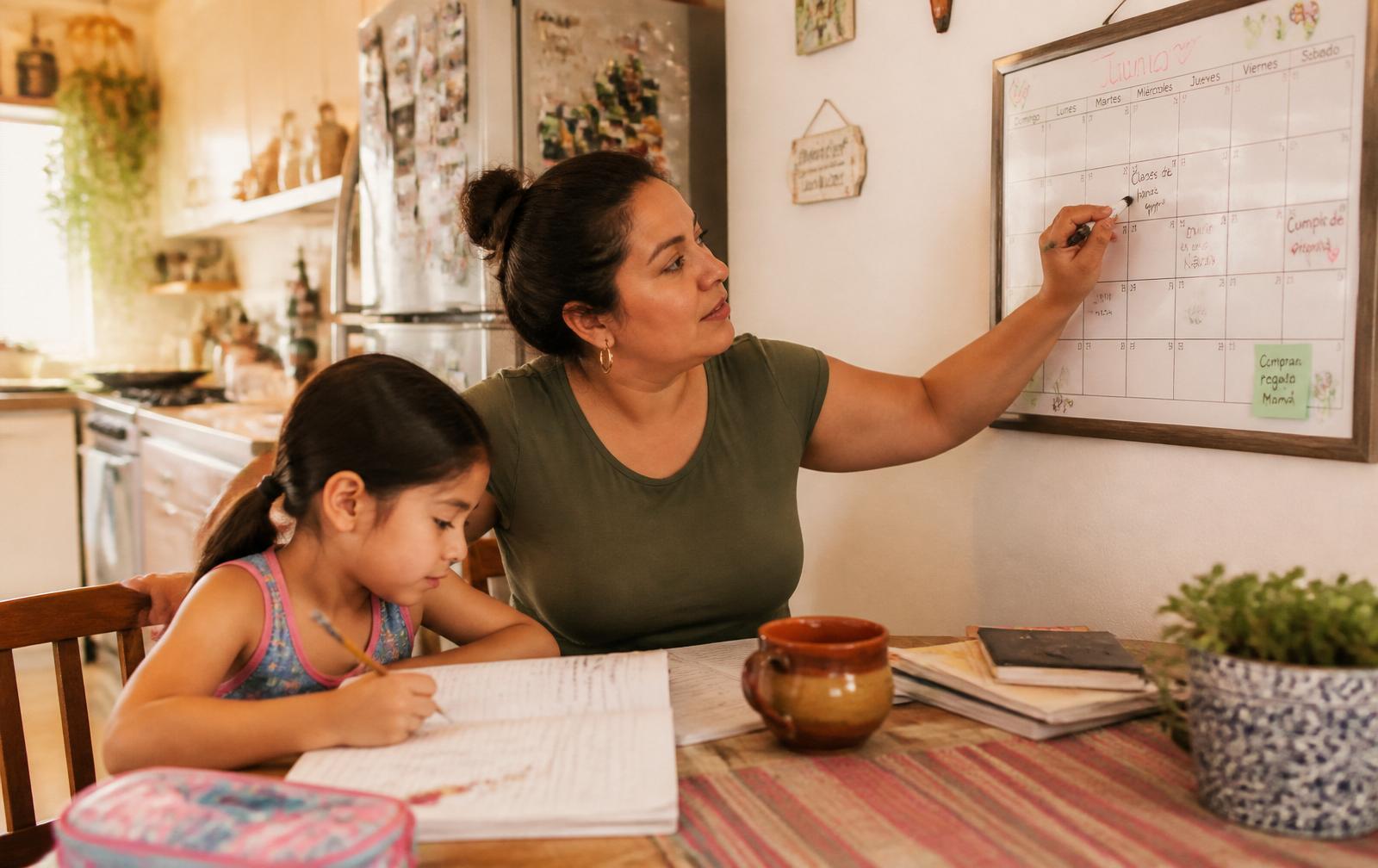
If you're a mom, this has probably happened to you: someone asks “so, what do you do?” and for a second you hesitate. You coordinate schedules, logistics, homework, health, meals, household finances and the emotional wellbeing of an entire family… but since none of that shows up on a payslip, it can feel like it “doesn't count”.
It does count. So much so that INEGI measures it every year in pesos and cents. Today we'll tell you how much that invisible work is worth, why almost no family protects it, and what you can do about it.
Unpaid work is worth nearly a quarter of the country's economy
Every year INEGI publishes the Satellite Account of Unpaid Household Work, a study that answers one very concrete question: if we had to pay someone for all the domestic and care work done for free in Mexican homes, how much would it cost?
The answer in the most recent edition (2024 data, published by INEGI in November 2025) is striking:
- Unpaid household work reached a value equivalent to 8 trillion pesos — 23.9% of national GDP. For perspective: housework is “worth” more than entire sectors of the formal economy.
- Women generated 72.6% of that value; men, 27.4%. In other words, the household work done by women contributes 2.7 times more value than that of men.
- On average, each woman contributed the equivalent of 82,339 pesos a year in domestic and care work. And note: that's the average across all women aged 12 and older — those who work full time at home contribute considerably more.
Curious about your own case? INEGI has a free calculator called “How much is my household work worth?” where you can enter your hours per activity and get your own figure. It's a five-minute exercise that changes the conversation at home.
The paradox: the most valuable work at home is the least protected
Here's the financial blind spot in most Mexican families.
When a family buys life insurance — and few do: according to the 2024 National Financial Inclusion Survey, only 13.9% of Mexicans aged 18 to 70 have a policy — they almost always insure only the person who earns the salary. The logic seems obvious: “if the income disappears, the family is unprotected”.
But that logic has a huge hole: what would happen if mom were gone?
Everything that costs nothing today because she does it would start costing money: childcare, transportation, meals, running the household, helping with homework. The family wouldn't only face the emotional blow — it would face a new, permanent and far-from-small monthly expense, at the worst possible moment. That is exactly the risk life insurance is designed to cover, and it's the one almost nobody covers.
In a family you don't insure whoever earns money; you insure whoever, if missing, would create an economic problem. By that definition, mom should almost always be insured — whether she works outside the home or inside it.
Three steps to put mom's value on the family financial map
1. Put a number on it
Use INEGI's calculator or do the quick math: how much would it cost to hire someone (or several people) to cover everything you do in a week? That figure is your starting point.
2. Review who is insured in your family
If the only policy is the one from your spouse's employer, be careful: group policies usually end when employment ends, and their coverage amounts rarely stretch across the years of school and university still ahead. If you want to compare how collective schemes work, take a look at our group life page.
3. Consider a life policy of your own, in your name
Beyond protecting your family, many life policies combine protection with long-term savings. That means something many moms deeply relate to: assets built in your own name, independent of any other household income. Before buying, always check that your agent is registered with the CNSF and review your rights as a user at CONDUSEF.
What we learned today
A mom's work has real, measurable and enormous economic value — INEGI prices it at nearly a quarter of the country's GDP. Treating it as “invisible” isn't just unfair: it's a financial risk for the whole family. Putting a number on it, reviewing existing policies and insuring mom (not only the paycheck earner) are three steps any family can take this month.
If you want to know what coverage amount would make sense in your case, GNP Life policies offer plans that combine protection and savings, adaptable to each family stage. At Donner & Asociados an advisor can help you size it with no obligation: write to us from our contact page or call 322 111 1162.
This article is informational and does not constitute personalized financial advice. Consult an advisor to assess your particular situation.
If you want to know what coverage amount would make sense in your case, a Donner & Asociados advisor can help you size a GNP Life policy that combines protection and savings — no strings attached.
Explore GNP Life insurance →This content is informational and educational. It is not personalized financial, tax or legal advice. Coverages, sums insured and conditions described are governed by each GNP product's General Conditions filed with the CNSF. For personalized advice, write to us or call +52 322 111 1162.
Keep reading

You already have pet insurance — do you know how to use it? A practical Mi Mascota GNP guide

Invoicing in Mexico: the key to getting your insurance claim paid (guide for foreigners)